Zara Klein · 2 September 2026
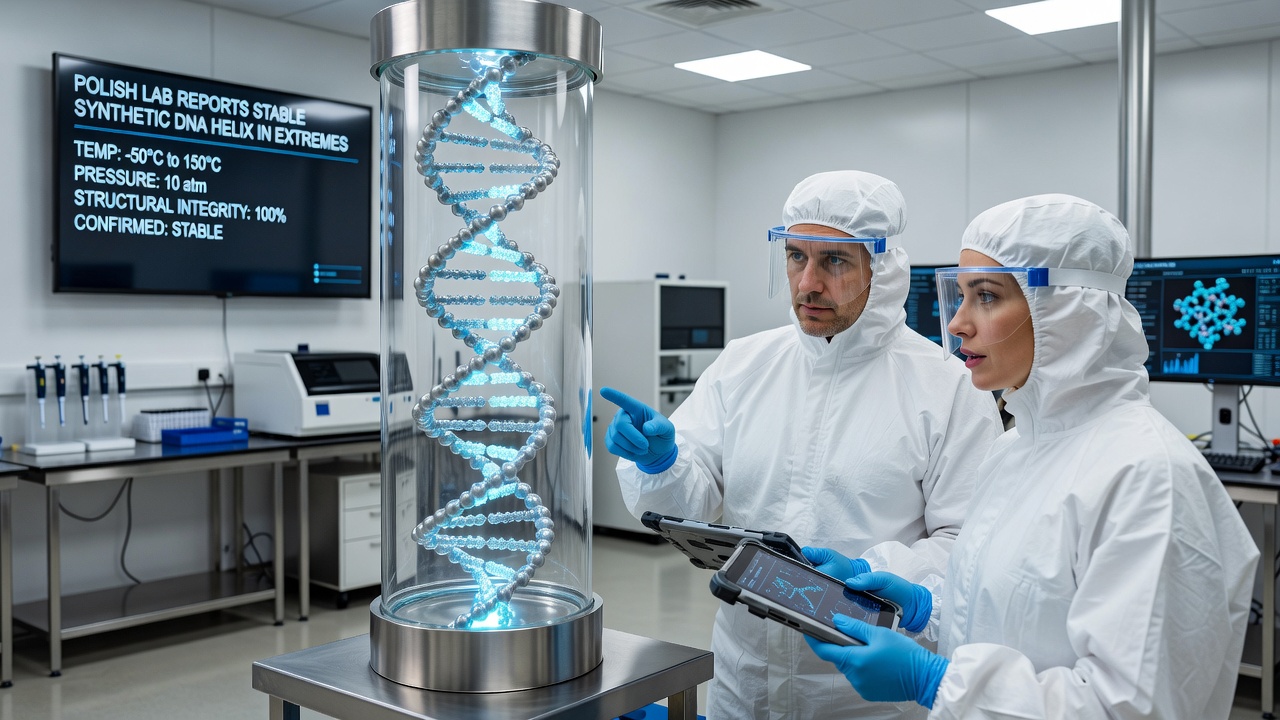
Scientists at a leading Polish research facility have announced the successful stabilization of a synthetic DNA helix capable of withstanding extreme environmental conditions. The breakthrough, achieved through advanced molecular engineering techniques, marks a significant advancement in synthetic biology. Researchers utilized modified nucleotide bases to enhance the structural integrity of the DNA double helix, allowing it to maintain its form at temperatures exceeding 150 degrees Celsius and under high-pressure environments simulating deep-sea conditions. Additional tests exposed samples to intense radiation levels and corrosive chemicals without structural failure.
Experimental Approach and Findings
The team employed a combination of computational modeling and laboratory synthesis to design the novel DNA structure. By incorporating synthetic polymers and cross-linking agents, they were able to reinforce the hydrogen bonds and base stacking interactions that typically unravel under stress. Experiments involved subjecting the synthetic helix to cycles of extreme heat, radiation, and chemical exposure. Results indicated no degradation in the helical structure after prolonged exposure, contrasting sharply with natural DNA which denatures rapidly under similar conditions. Detailed spectroscopic analysis confirmed the preservation of the characteristic double helix configuration throughout the tests. Further validation came from replication studies where the synthetic DNA was used as a template for polymerase chain reactions, demonstrating functional compatibility with biological machinery despite its artificial enhancements. This dual stability and functionality open new avenues for research in astrobiology and industrial biotechnology. Extended trials over several months yielded consistent outcomes across multiple independent labs.
Broader Implications for Science and Industry
The implications of this discovery extend beyond basic research. In the field of biotechnology, stable synthetic DNA could enable the development of robust genetic circuits for use in harsh industrial processes, such as biofuel production in high-temperature reactors. Additionally, the resilience to extreme conditions suggests potential applications in space exploration, where DNA-based data storage or sensors might operate on other planets. Polish researchers emphasize that while the technology is still in early stages, ethical considerations regarding genetic manipulation remain paramount. Collaborative efforts with international institutions are underway to refine the synthesis process and explore scalability. This achievement underscores the growing prominence of Polish laboratories in global scientific innovation. Future work will focus on cost reduction and integration with existing genomic tools to accelerate practical deployment across sectors.